
If you’re a man who loves to keep warm in style, then this free men’s beanie knitting pattern is just for you. Whether it’s a chilly winter’s day or a cool autumn morning, this beanie will quickly become a staple in your wardrobe. Made with soft and cozy yarn, it’s not only comfortable to wear but also easy to knit.
The pattern is suitable for beginners and experienced knitters alike, with clear and concise instructions that are easy to follow. With just a few basic knitting stitches, you’ll have a stylish beanie in no time. Plus, it’s completely customizable, allowing you to choose your favorite colors and stitch patterns to make it truly unique.
Not only is this beanie a fashionable accessory, but it also makes for a thoughtful and practical gift. Whether you’re knitting it for yourself or for someone special, it’s sure to be appreciated. So grab your knitting needles and get ready to create a beanie that will keep you warm and stylish all winter long.
Men’s Beanie Knitting Pattern Free

Are you looking for a free knitting pattern for a men’s beanie? Look no further! We have a fantastic pattern that is perfect for keeping you or your loved one warm and stylish during the colder months.
This men’s beanie knitting pattern is designed to be easy to follow and suitable for knitters of all skill levels. Whether you are a beginner or a seasoned pro, you will be able to create a beautiful and functional beanie with this pattern.
Materials:
- Yarn – choose a bulky weight yarn in the color of your choice
- Knitting needles – size 8 (5mm) circular needles or double-pointed needles
- Stitch marker
- Tapestry needle for weaving in ends
Instructions:
- Cast on 80 stitches using the long tail cast on method.
- Join in the round, being careful not to twist the stitches. Place a stitch marker to indicate the beginning of the round.
- Knit in the round in a 2×2 rib stitch pattern (knit 2 stitches, purl 2 stitches) for 2 inches.
- Switch to stockinette stitch (knit every round) and continue knitting until the beanie measures approximately 8 inches from the cast on edge.
- Begin decreasing:
- Round 1: *Knit 6, knit 2 together* Repeat from * to * to the end of the round.
- Round 2: Knit all stitches.
- Round 3: *Knit 5, knit 2 together* Repeat from * to * to the end of the round.
- Continue in this manner, decreasing the number of knit stitches by 1 in each repeat, until you have 8 stitches remaining.
- Cut the yarn, leaving a long tail. Thread the tail through the remaining stitches, pull tight to close the top of the beanie, and weave in all loose ends.
And there you have it – a cozy and stylish men’s beanie that you can knit for free! This pattern is easily customizable, so feel free to experiment with different yarns, colors, and stitch patterns to make it your own. Happy knitting!
Choosing the Right Yarn and Needles

When it comes to knitting a men’s beanie, choosing the right yarn and needles is essential to create a high-quality and stylish accessory. Yarn selection plays a significant role in determining the warmth, durability, and overall comfort of the finished hat.
Yarn Weight: The first consideration is the weight of the yarn. Most men’s beanies are knit using worsted weight yarn, which provides a good balance of warmth and softness. However, if you’re looking for a lighter or heavier beanie, you can choose yarn that is categorized as either sport weight or bulky weight, respectively.
Yarn Fiber: The fiber composition of the yarn will also affect the characteristics of the beanie. Natural fibers like wool and alpaca are popular choices for winter beanies due to their excellent insulation properties. Acrylic yarn is a more affordable option and is often favored for its durability and easy care. Choosing a yarn with a blend of fibers can combine the best qualities of each material.
Needle Size: The right needle size is crucial for achieving the desired gauge and ensuring a properly fitting beanie. The recommended needle size is usually indicated on the yarn label. However, this may vary depending on your personal knitting tension. It’s always a good idea to make a gauge swatch before starting the project to ensure that your needle size is appropriate.
Additional Considerations: Apart from yarn weight and needle size, other considerations for choosing the right materials for your men’s beanie include the color and texture of the yarn. Consider the wearer’s personal style and preferences when selecting the yarn color, and also take into account the desired look and feel of the finished beanie.
Casting On

Before you can start knitting your men’s beanie, you need to know how to cast on stitches. Casting on is the process of creating the initial row of stitches on your knitting needle. There are several different methods of casting on, but one common method that is perfect for beginners is the long-tail cast on.
The long-tail cast on:
To begin the long-tail cast on, first, you need to estimate the amount of yarn you’ll need for the cast on. You can do this by measuring the yarn against your needle, leaving a long tail. Then, make a slipknot and place it on your needle. The slipknot counts as your first stitch.
Next, hold the needle with the slipknot in your right hand and the yarn in your left hand. With your left thumb and index finger, pinch the tail of the yarn against the needle. This will create a loop.
Now, take the yarn attached to the ball and bring it over the top of the needle from front to back. Then, bring the needle through the loop you created with your left hand, going from back to front. This will create a new stitch on your needle. Repeat this process until you have cast on the desired number of stitches.
Once you have finished casting on, you are ready to start knitting your men’s beanie! Make sure to keep the tension of your stitches even and watch out for any twisted stitches. Happy knitting!
The ribbing stitch is a commonly used stitch pattern in knitting. It creates a stretchy and textured fabric, making it perfect for items like hats, scarves, and cuffs. The ribbing stitch is achieved by alternating knit and purl stitches within a row.
To create the ribbing stitch, begin by casting on an even number of stitches. The most common ribbing pattern is the 1×1 rib, which means alternating between one knit stitch and one purl stitch. This creates a neat and reversible fabric that has a tendency to retract, giving it its stretchy quality.
How to knit the ribbing stitch

- Start by casting on an even number of stitches.
- Row 1: *Knit 1, purl 1* Repeat from * to * until the end of the row.
- Row 2: *Purl 1, knit 1* Repeat from * to * until the end of the row.
- Repeat rows 1 and 2 until the desired length is reached.
- Bind off in pattern.
By adjusting the number of knit and purl stitches in each row, you can create different types of ribbing patterns. For example, a 2×2 ribbing pattern is achieved by alternating between two knit stitches and two purl stitches. Experiment with different ribbing patterns to add variety and interest to your knitted projects.
The ribbing stitch not only adds texture to your knitted items but also helps them stay in place and fit comfortably. Whether you’re knitting a beanie, a scarf, or a pair of cuffs, the ribbing stitch is a versatile technique that can elevate your knitting projects.
Body of the Beanie

Once you have completed the ribbed brim of the beanie, it’s time to move on to the body. The body is where you will start knitting in the round to create the cylindrical shape of the beanie.
To begin, switch to your larger circular needles. Make sure your stitches are divided evenly onto your needles, with half of the stitches on each needle. Join in the round, being careful not to twist your stitches.
Rounds 1-5: Knit all stitches in the round. This will create the stockinette stitch pattern for the body of the beanie.
Round 6: Begin the decrease rounds for the top of the beanie. Knit 2 stitches together, and repeat this decrease stitch pattern for the entire round. This will decrease the total number of stitches by half.
Rounds 7-8: Continue knitting all stitches in the round.
- Round 9: Repeat the decrease round by knitting 2 stitches together for the entire round.
- Round 10: Knit all stitches in the round.
- Round 11: Repeat the decrease round by knitting 2 stitches together for the entire round.
- Round 12: Knit all stitches in the round.
- Round 13: Repeat the decrease round by knitting 2 stitches together for the entire round.
- Round 14: Knit all stitches in the round.
Continue in this pattern, alternating between a decrease round and a knit round, until you have a small number of stitches remaining.
Next, cut your working yarn, leaving a long tail. Thread the tail through a yarn needle, and use the needle to draw the yarn through the remaining stitches. Pull tight to close the top of the beanie.
Lay the beanie flat and weave in any loose ends. Your beanie is now complete and ready to be worn or gifted!
Decreasing Stitches

When knitting a men’s beanie, you may need to decrease stitches in order to shape the crown of the hat. Decreasing stitches helps create a tapered fit and ensures that the beanie fits snugly on the head. There are several methods you can use to decrease stitches, depending on the desired effect and the pattern you are following.
1. Knit 2 Together (K2tog)
The knit 2 together (K2tog) decrease is a common method used in knitting to decrease stitches. To execute this decrease, simply insert your right needle into the next two stitches as if to knit them together, and then knit them both as if they were one stitch. This will decrease the stitch count by one.
2. Slip, Slip, Knit (SSK)
The slip, slip, knit (SSK) decrease is another common method that creates a left-leaning decrease. To perform the SSK decrease, slip the next two stitches knitwise, one at a time, onto your right needle. Then insert the left needle into the front loops of these two slipped stitches and knit them together through the back loops. This will also decrease the stitch count by one.
3. Purl 2 Together (P2tog)
If you are working a pattern that includes purl stitches, you can use the purl 2 together (P2tog) decrease to decrease stitches on the purl side. To do this decrease, simply insert your right needle into the next two stitches as if to purl them together, and then purl them both as if they were one stitch. This will decrease the stitch count by one.
4. Central Double Decrease (CDD)
The central double decrease (CDD) is a method used when you want to decrease two stitches in the center of your work simultaneously. To execute this decrease, slip two stitches knitwise, one at a time, onto your right needle. Then insert the left needle into the front loops of these two slipped stitches and knit them together through the back loops. Next, insert the left needle into the front loop of the first slipped stitch and pass it over the second slipped stitch and off the right needle. This will decrease the stitch count by two in the center.
When decreasing stitches in a beanie pattern, it is important to carefully follow the instructions provided in the pattern. By using the appropriate decrease method, you can shape the beanie to fit perfectly and create a professional-looking finished product.
Shaping the Crown

Shaping the crown of a men’s beanie is an important step in the knitting process. It is what gives the beanie its characteristic shape and ensures a comfortable fit for the wearer. There are several methods that can be used to shape the crown, depending on the desired style and complexity of the pattern.
One common method for shaping the crown is the decrease rounds. This involves reducing the number of stitches in each round to create a tapered shape. Typically, decreases are made by knitting two stitches together or slipping stitches. The exact decrease pattern will depend on the specific knitting pattern being followed.
Another method for shaping the crown is the short rows technique. This involves knitting partway across a row, then turning the work and knitting back in the opposite direction. By repeating this process, it is possible to create a rounded shape. Short rows can be a bit more complex than decrease rounds, but they offer more versatility in terms of shaping options.
Regardless of the method used, it is important to carefully follow the instructions provided in the knitting pattern. Any mistakes or deviations from the pattern could result in an ill-fitting or misshapen crown. Additionally, it may be helpful to use stitch markers to keep track of the shaping process and ensure accuracy.
Changing Colors

Changing colors in your men’s beanie can add a pop of visual interest and make your knitwear truly unique. Whether you want to create bold stripes or subtle ombre effects, the possibilities are endless. With the right knitting pattern and yarn, you can easily incorporate color changes into your design.
One popular technique for changing colors in knitting is stranded colorwork, also known as Fair Isle knitting. This technique involves knitting with two or more colors of yarn in each row or round, carrying the unused yarn loosely behind your work. By knitting with different colors in different rows, you can create intricate patterns and designs. Fair Isle is often used to create geometric motifs or floral patterns on hats and other accessories.
If you prefer a simpler color change, you can also try using self-striping yarn. Self-striping yarn is pre-dyed with multiple colors, so as you knit, the yarn automatically changes colors on its own. This eliminates the need for carrying multiple yarns and allows you to achieve a striped effect without any extra effort.
When working with multiple colors, it’s important to consider the impact on the overall design. You may want to choose colors that complement each other or create a contrasting effect. Swatching with different color combinations can help you determine which colors work well together and achieve the desired effect.
Changing colors in your men’s beanie can be a fun and creative way to personalize your knitwear. Whether you choose to experiment with intricate Fair Isle patterns or use self-striping yarn for a simpler effect, adding color to your knitting can take your project to the next level.
Adding Texture and Design

When knitting a men’s beanie, adding texture and design can take it to the next level. There are several techniques and stitches that can be used to create interesting patterns and visual interest in the knitted fabric.
Cables: Cables are a classic choice for adding texture to a knit beanie. They create a woven or braided effect and can be combined with other stitches to create unique patterns. To knit cables, stitches are crossed over each other, typically using a cable needle. This creates a raised texture and adds depth to the design.
Colorwork: Incorporating colorwork into a men’s beanie can create a striking design. Fair Isle and stranded knitting are popular techniques for adding colorwork to hats. These techniques involve knitting with two or more colors of yarn in each row, creating intricate patterns or motifs. Colorwork can be used to create stripes, checkerboard patterns, or even more intricate designs.
Ribbing: Ribbing is a popular choice for the brim of a beanie as it provides stretch and a snug fit. It is also a great way to add texture and design to the hat. Ribbing is created by alternating knit and purl stitches in a specific pattern, such as 2×2 ribbing or 3×1 ribbing. This creates a vertical texture that can be visually appealing.
Seed Stitch: The seed stitch is another option for adding texture to a knit beanie. It is created by alternating knit and purl stitches in a specific pattern, such as knitting one stitch and purling the next. This creates a bumpy texture that can add depth and visual interest to the hat.
Slip Stitch Patterns: Using slip stitch patterns can create interesting textures and designs in a beanie. Slip stitches are created by passing a stitch from the left needle to the right needle without knitting or purling it. By strategically slipping stitches, patterns can be created, such as diagonal lines or zigzag shapes.
Incorporating these techniques and stitches into a men’s beanie can transform a simple design into a visually appealing and unique accessory. Whether it’s cables, colorwork, ribbing, seed stitch, or slip stitch patterns, there are countless possibilities for adding texture and design to a knitted beanie.
Finishing Off

After you have completed knitting your beanie, it’s time to finish off the project. This final step will give your beanie a polished look and ensure that all loose ends are secured. Here are a few steps to follow when finishing off your men’s beanie:
Weaving in Ends

Start by weaving in all the loose ends of yarn that were created during the knitting process. Take a tapestry needle and thread it with one end of the yarn. Insert the needle into the wrong side of the beanie, close to where the end is located. Weave the needle through the stitches, going back and forth in a zigzag motion, for about an inch or so. Trim any excess yarn, leaving a small tail.
Blocking
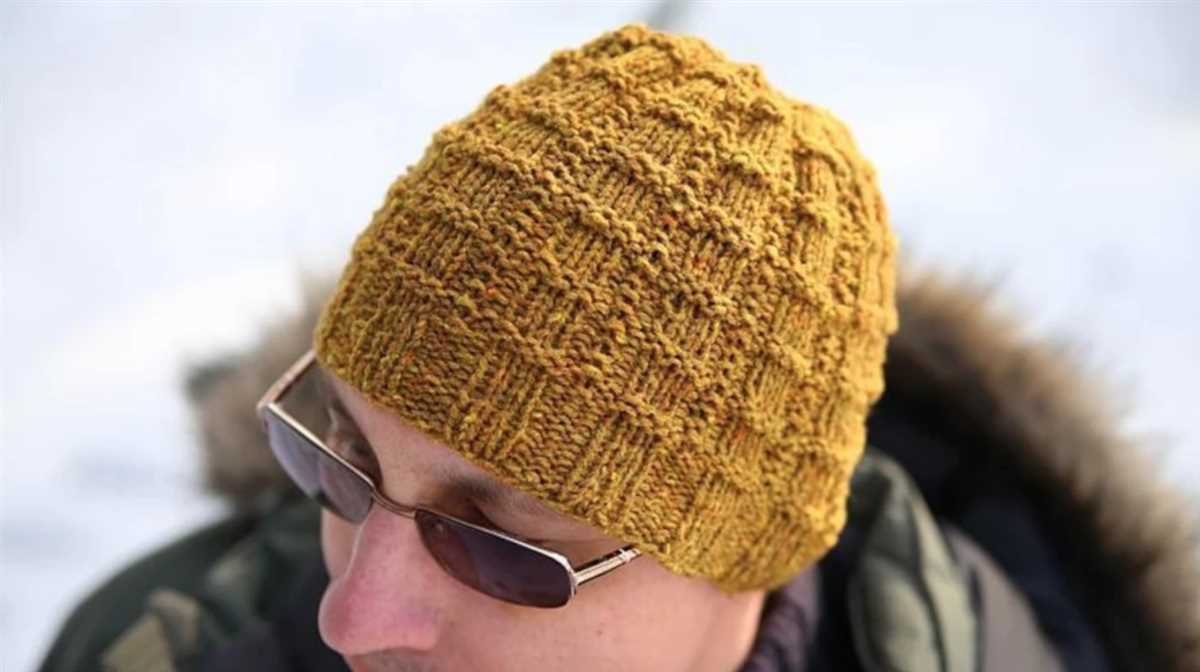
Blocking is an important step in knitting that helps to shape and smooth the fabric. To block your beanie, soak it in cold water for about 15 minutes. Gently squeeze out the excess water, being careful not to wring or twist the fabric. Lay the beanie flat on a clean towel and reshape it to the desired size and shape. Allow it to dry completely before wearing or storing.
By following these finishing off steps, you can ensure that your men’s beanie looks professional and well-made. Take the time to complete these final touches and enjoy the satisfaction of a completed project.
Tips and Variations

A men’s beanie is a versatile and stylish accessory that can be customized in various ways. Here are some tips and variations to consider when knitting your own beanie:
Choose the yarn based on the level of warmth and comfort you want for your beanie. Opt for a soft and cozy yarn for the winter months, or a lighter yarn for a spring or fall beanie.
2. Color Combination:
Experiment with different color combinations to add a unique touch to your beanie. You can create stripes or use different colors for the ribbed brim and the body of the beanie.
3. Pattern Variation:
Try different stitch patterns to create different textures and designs. For example, you can use a ribbed stitch pattern for the entire beanie or switch to a stockinette stitch for the body.
4. Embellishments:
Add embellishments such as pom poms, buttons, or patches to personalize your beanie and give it a distinctive look.
5. Size Adjustment:
If you want to adjust the size of the beanie, you can easily do so by adding or subtracting stitches in the ribbed brim or adjusting the number of rows in the body.
6. Blocking:
After finishing your beanie, consider blocking it to shape the stitches and improve the overall appearance. Blocking can be done by wetting the beanie, gently shaping it, and allowing it to dry flat.
7. Gift Ideas:
A hand-knitted beanie makes a thoughtful and personal gift. Consider knitting beanies for family and friends, customizing each one to suit their style and preferences.
With these tips and variations, you can take your men’s beanie knitting project to the next level. Whether you’re a beginner or an experienced knitter, enjoy the process of creating a cozy and fashionable accessory that will keep you warm throughout the colder months.
